The Project’s History
In 2010 Dr. Mandy Spivak and Dr. Nicholas Perna set out to create a guide of the songs of Benjamin Britten for voice teachers and singers. Much of Britten's well-known output on recording and in print is quite challenging. However, upon examination of his complete works, the authors realized that it would be possible to break his works into voice ability levels. Categorizing the songs by ability level will allow voice teachers and singers more ease in examination of his catalog.
To garner a more complete picture of Britten's song catalog, the authors spent a two-week residency in the Britten-Pears library at the Red House in July 2011. While there, they examined the composer's sketches of the major song cycles and were granted access to analyze all of Britten's unpublished, complete juvenile songs for inclusion in this database.
Included in the database are Britten's solo songs with piano, solo songs with single instrumental accompaniment (i. e. harp), orchestral songs with accessible piano reductions, and the folk song arrangements. Excluded from the database are operatic arias, orchestral songs without accessible piano reductions, songs for more than one voice, and the Purcell realizations. After extensive discussion, the authors felt that the folksongs were truly Britten's, whereas, the realizations, while inventive, were still Purcell's.
This labor of love has been a four year process. Their poster presentation at the 2012 National Association of Teachers of Singing (NATS) National Conference was awarded "best poster." The complete database and website was unveiled at the 8th International Congress of Voice Teachers (ICVT 8) in Brisbane, Australia, in July 2013.
Voice Difficulty Levels Defined
Moderately Easy
Limited Range, Short Phrases, Time to Breathe, Moderate Phrase Length, Descending Phrases, No Sustained High Pitches, Supportive Accompaniment
Moderate
Slightly Longer Phrases, Few Sustained High Pitches, Accompaniment is Supportive, but Contains Some Complex Musical Gestures
Moderately Difficult
Longer Phrases, Sustained Higher Pitches, Complicated Rhythms, Accompaniment May Diverge From Singer in Pitch and Rhythm
Difficult
Requires Advanced Artistry and Collaboration. Most Often Composed for Specific World Class Artists
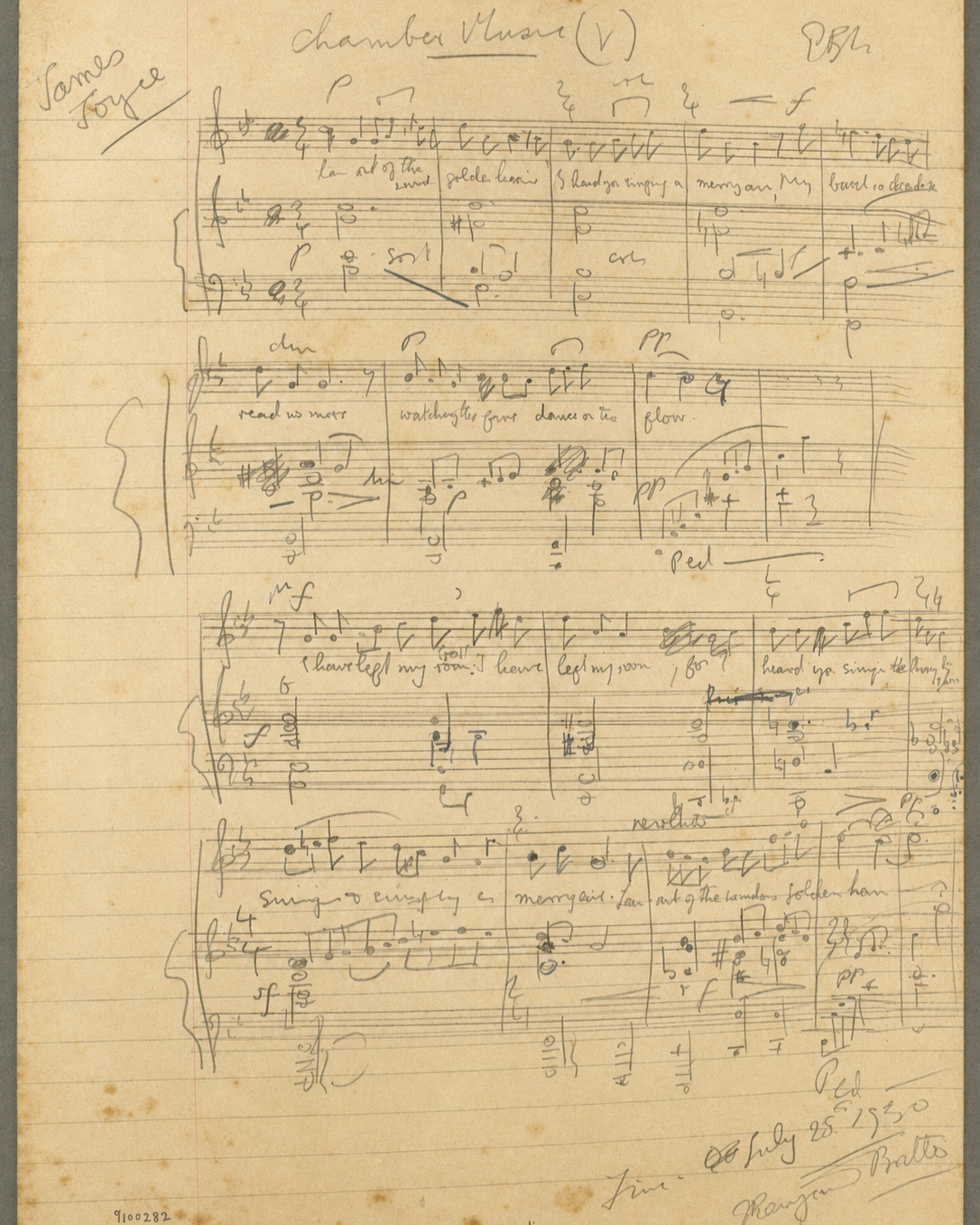
Photograph of title page of Britten’s early composition “Chamber Music V” from composer’s sketch. Picture credit: Nicholas Perna and Mandy Spivak, 2011, taken at the Britten Pears Library, Aldeburgh, England. Copyright 2011.
What is in Each Annotation?
Title: The song title. For duplicate titles, the initials of the complete work are in parentheses.
Poet: For many folksongs, an additional category of "Collector" is listed, if known.
Source: Larger work, cycle, or collection, if any.
Date of Composition: Date of actual composition, rather than publication.
Publication: Company and edition used for analysis, if applicable.
Voice Difficulty Level: See Above.
Subject: Short poetic description.
Range: Lowest printed note to highest printed note. Range notated as it appears regardless of octave for voice type.
Tessitura: Area in which most of the singing lies.
Tempo: The composer's indication and time signature at the beginning of the piece.
Duration: The authors' timings.
Vocal Characteristics: Any aspect of the vocal line that the authors found noteworthy.
Piano Difficulty Level: See Piano Ability Levels
Accompaniment Characteristics: Description of basic accompaniment features.
Additional Comments: Any additional information that may be important in the selection of repertoire. Includes many links to additional information from the Britten Thematic Catalog http://www.brittenproject.org/
Piano Ability Levels
Easy
Mostly within the “five finger position,” no great variance in speed, dynamics, or texture, uncomplicated rhythms
Moderate
Triads in single hand, up to two individual voices, parallel intervals, ornaments, movement outside of “five finger position,” more complicated rhythms
Difficult
Characteristics:
More than three voices, chords with four notes, differing techniques within a single hand, repeated movement of hand position